
Dr. Will French is an equine veterinarian at Littleton Equine Medical Center, just outside Denver, Colorado, where his work centers on sports medicine, lameness evaluation and diagnostic imaging. A Colorado State University graduate, he completed his internship at Littleton Equine and never left. Today, he is both a shareholder in the practice and an ISELP-certified veterinarian, serving on the organization’s board.
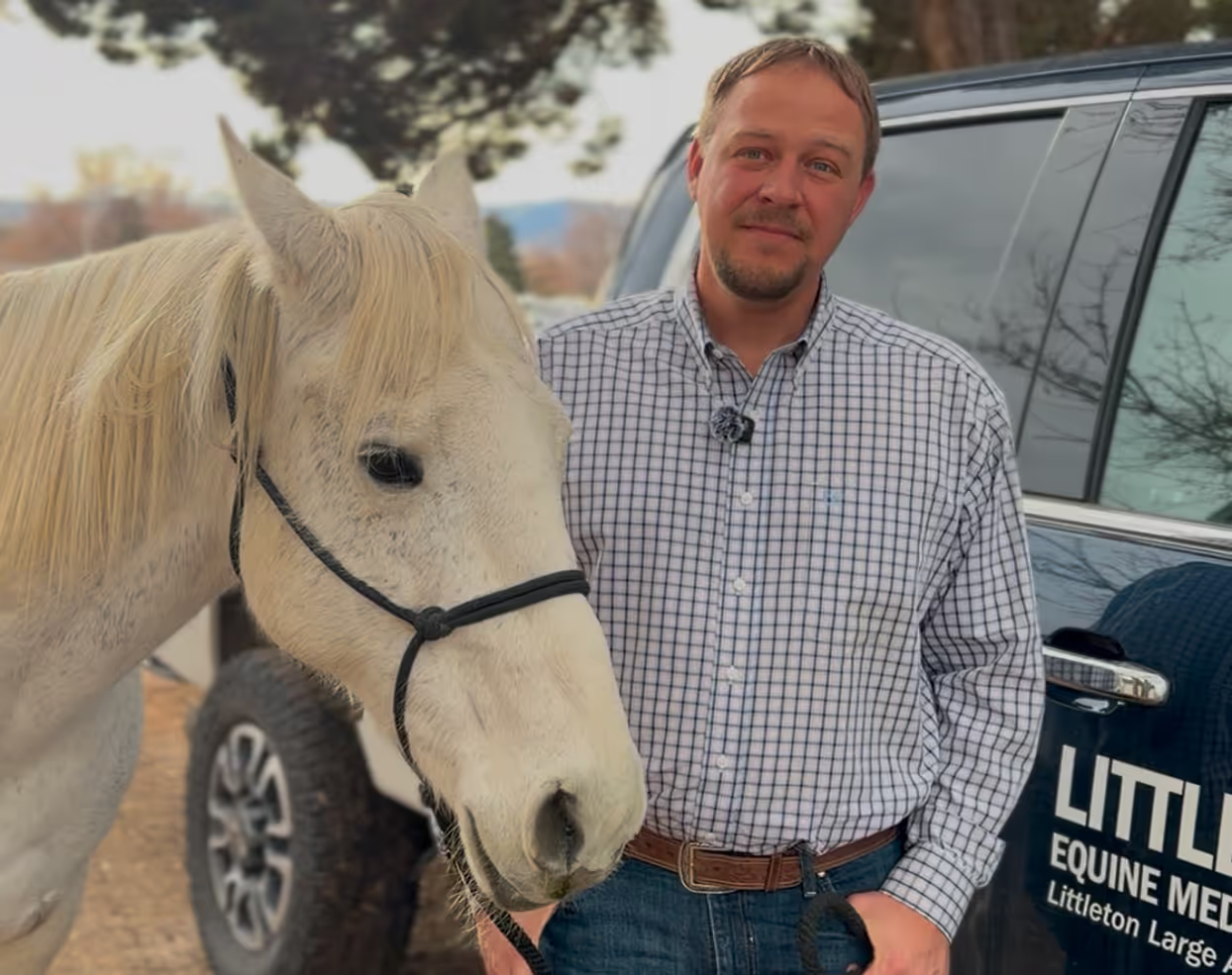
Littleton Equine Medical Center marked its 75th anniversary in 2025 — a testament to the enduring the vision of its founders, Dr. Marvin Beeman, Dr. Terry Swanson, and Dr. Charlie Vail. Their ambition was simple but far-reaching: to deliver high-quality equine veterinary medicine at a time when such standards were still taking shape. “We joke that the rest of us are just trying to catch up with what they built,” Dr. French says.
Now a large referral hospital with more than 25 veterinarians, advanced diagnostics, and specialist care, Littleton Equine combines technical capability with a culture shaped by its history. Compassion for horses and their people, professionalism, and a genuine passion for the industry continue to guide how medicine is practiced — values passed down directly from its founders.
“We want to provide the best possible medicine and technology,” Dr. French explains, “but just as importantly, we want to meet each horse and owner where they are. Not every case needs — or can support — every gold standard diagnostic. Our job is to help owners understand their options and find the right path forward.”
At the heart of every lameness case, Dr. French says, is a shared effort to understand what the horse is telling you. The clinical exam is only one part of that process. History from the owner, rider, or trainer, careful observation, palpation, and watching the horse move — sometimes under saddle, sometimes doing its actual job — all contribute pieces tof the puzzle.
“Putting your hands on the horse is foundational,” he explains. “But it’s never just one thing. It’s understanding what the horse does for a job, correlating what you find on the exam, and circling it all together.” Especially in ridden or performance evaluations, interpretation can be complex. Rider influence, training factors, and subtle performance changes can blur the line between pain and management, making clear communication essential.
This is where alignment between veterinarian and client matters most. Not every concern has a simple answer, and not every finding demands immediate action. The task, Dr. French says, is to work toward a shared understanding of the horse’s current health status — what is known, what is uncertain, and what deserves attention moving forward.
Objective gait analysis has become a valuable addition to Dr. French’s clinical toolbox – not as a replacement for judgement, but as a way to support decisions and guide conversations.
“It’s great to have something visual to share with clients,” he explains. “For years, the lameness exam result has been what the veterinarian says. Many clients are very educated horse people, and sometimes there’s a difference of opinion — and that’s okay. It’s nice to have another data point and say, ‘Here’s what this says — let’s look at it together.’”
He also highlights something that many veterinarians recognize: clients are often overloaded in the exam room.
“We probably say too much sometimes,” he says. “It’s information overload. This is what we do every day — it’s not what they do every day. Having a visual of where we’re at is really useful for some people.”
Interpreting movement data requires nuance. “Not many horses have zero asymmetry,” he points out. “It’s like us.” The value of the data lies not in the numbers alone, but in understanding what they mean for that individual horse — what is significant, what should be monitored, and what is acceptable for the job the horse is asked to do.
Used thoughtfully, movement data becomes a tool for shared understanding rather than a source of alarm. It allows veterinarians to explain not only what they are seeing, but why it matters — or doesn’t. By framing asymmetry within a broader clinical picture, Dr. French says, veterinarians can help clients feel informed and involved, while still leading the decision-making process in a way that supports both trust and long-term welfare.
For clients travelling long distances to the clinic, remote follow-ups have become a way to maintain continuity and connection.
“Some of our clients come from multiple states away,” Dr. French says. “Remote monitoring makes it possible to have more frequent conversations about how the horse is doing.” These follow-ups often lead to a phone call or email discussion, reinforcing a relationship that extends beyond a single visit. “That relationship really is foundational,” he adds.
One of the most striking parts of Dr. French’s perspective is how he responds when the data and his clinical impression don’t immediately align.
“When there’s a conflict between what I see and what Sleip shows, I think: ‘This is not what I saw — let’s dive deeper.’ That might be watching the horse again and asking why the asymmetry was detected.”
He emphasizes that it doesn’t have to be framed as a battle of "vet versus tech".
“It doesn’t necessarily mean I’m wrong or Sleip is wrong,” he says. “It’s another piece of information that makes you look closer. Sometimes it’s something I missed. Sometimes it’s a difference in how pronounced it looks. Either way, it’s a good way to check yourself.”
Dr. French is candid about the emotional challenge that comes with being evaluated—whether by clients, colleagues, or technology.
“It’s okay to be wrong,” he says. “That’s a bigger conversation as a profession, and especially younger veterinarians need to hear it.”
But he also acknowledges the real difficulty: being wrong can feel risky.
“The ability to say that to a client is really hard,” he says. “We don’t want to lose the client. They don’t want us to be wrong. But we’re human.”
For Dr. French, the solution returns to trust and values.
“If a client says, ‘I don’t want a veterinarian who’s ever wrong — you’re fired,’ then okay—keep looking. Because what I’m going to say is: I’m going to be honest about when I screwed up.”
And that ties back to what he believes is one of the core challenges of veterinary work:
“There’s a fine line between being confident about what you see — and being humble enough to say, ‘Maybe we need to change course.’ But if the goal is doing the best thing for the horse, sometimes you have to change course in the face of new information.”
At Sleip, we are “Here for the Horse”, and dedicated to the ongoing conversation between those who care for them. We extend our special thanks to Dr. French and Littleton Large for sharing their Sleip story with us.


.avif)