
Students have to learn to recognise subtle changes in movement, follow a clinician’s reasoning and make decisions while the horse is moving in front of them. Once they graduate, they are expected to apply that judgement in practice, often with less immediate support.
At the University of Pennsylvania’s New Bolton Center, Dr Kyla Ortved teaches third- and fourth-year students during surgery and sports medicine rotations. Objective gait analysis, including Sleip, has become part of that clinical teaching.

“We’ve been using it to help teach lameness in real time,” she says.
The value, in her view, is not simply the measurement itself, but the opportunity to revisit an examination and discuss it.
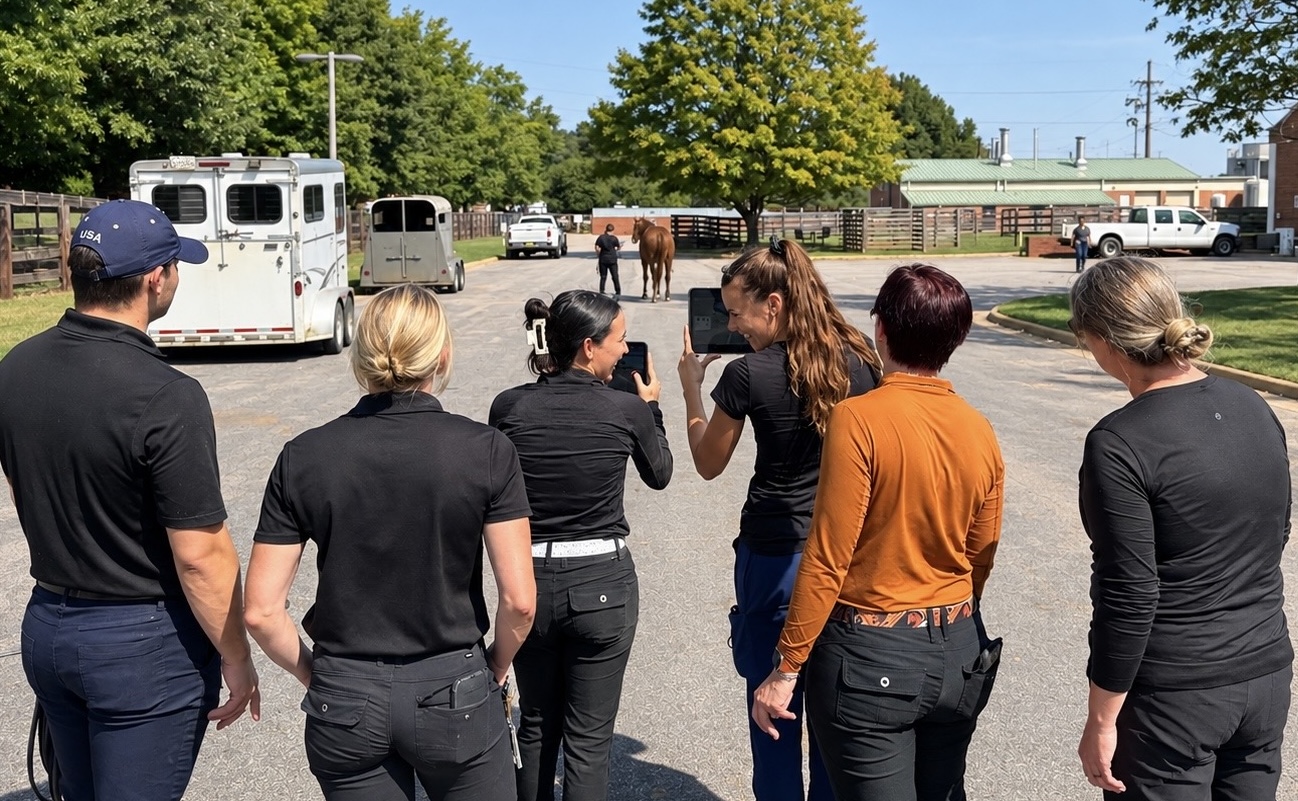
Students can assess a horse first, then review the recording with the clinician, slowing the movement down and comparing their interpretation with the gait data.
Ortved describes this as a way to bring together “what you were seeing, what you think you were seeing and what the technology’s telling us”.
For students, that creates another opportunity to connect theory with what happens in front of them. For educators, it provides a way to stop and revisit a moment that would otherwise have passed.
That learning challenge does not disappear at graduation.
Early-career equine vets are building clinical judgement while also learning to manage clients, workload and professional responsibility — often with less immediate access to feedback.
For equine practice, that transition is particularly important. Young vets are expected to become clinically independent while entering a part of the profession that is already working hard to attract and retain them. Ortved points to familiar structural pressures, including on-call commitments, less predictable working patterns and competition from small-animal practice.
She also sees signs of change, from more shared emergency cover to clearer pathways in areas such as sports medicine. But there is another question too: how well are young vets supported as they move from supervised learning into independent decision-making?
Lameness is a good example. It is a skill built through repetition, comparison and discussion, yet newly qualified vets increasingly have to trust their own judgement in the field.
“There’s still so much to learn,” Ortved says of those early years.
In that context, objective gait analysis can provide an additional reference point: something a young vet can use to review a case, compare impressions and, where needed, discuss the same recording with a more experienced colleague.
It cannot solve the wider pressures facing equine practice. But it can make one part of the transition — continuing to learn while taking on greater responsibility — better supported.
Penn Vet is not the only university asking how technology might support that learning process. Objective gait analysis is already well established in university research and specialist equine hospitals; what is changing is its place in education. As the technology has become more accessible, students are beginning to encounter it not only during clinical rotations, but increasingly as part of how lameness itself is taught.
At North Carolina State University, Dr Emily Martin is leading a study examining whether access to video review in slow-motion, coupled with objective gait data can improve students’ accuracy, confidence, and retention in lameness assessment. (Read more about the study here.)
Students still need live horses, experienced clinicians, discussion and time. But veterinary schools are beginning to experiment with ways of giving them more opportunities to review what they see and test their own judgement.
For a profession concerned with both clinical competence and the transition of young vets into practice, that kind of supported learning could become an increasingly important part of veterinary education.


.avif)